Why Your Pack Weight Punishes You on the Descent, Not the Climb
Quick Answer: Going uphill is mostly concentric muscle work, which is metabolically hard but mechanically gentle. Going downhill is eccentric work, where the quadriceps decelerate your body weight plus your pack on every single step, and joint forces at the knee can reach several times body weight. Extra pack weight multiplies that on every descent step. Trekking poles reduce lower-limb loading meaningfully, shorter steps reduce it further, and training the descent is the part almost nobody does.
The climb felt hard and the descent felt easy. Two days later you can barely go down stairs.
That is the descent’s bill arriving, and it is entirely predictable.
Why is downhill harder on the body than uphill?
Uphill is concentric work - muscles shorten to lift you. It burns energy, taxes the cardiovascular system and produces relatively little muscle damage.
Downhill is eccentric work - the quadriceps lengthen under load to control your descent. Eccentric contractions produce far more muscle damage and delayed-onset soreness than concentric ones at equivalent effort.
Joint forces are much higher going down. Each step involves absorbing impact rather than generating lift, and knee joint forces on descent are commonly cited at multiple times body weight.
Pack weight scales all of it. Every additional pound is an additional pound to decelerate, thousands of times over a long descent.
Perceived effort is misleading because breathing and heart rate are lower going down. The mechanical cost is high while the metabolic signal is quiet, which is exactly the combination that leads people to overdo it.
And fatigue makes it worse as you go. Tired quadriceps absorb less, so more force reaches the joint - which is why the last mile of a descent is the one that hurts.
How much does pack weight actually matter?
A common guideline is a day pack at or under about 10 percent of body weight, and overnight loads at 20 percent or below, though individual conditioning matters more than any single ratio.
Water is the heaviest thing most people carry at roughly 2.2 pounds per litre. Knowing where refill points are can remove several pounds from a day pack.
Weight distribution changes perceived load substantially. Heavy items high and close to the spine feel lighter and disturb balance less than the same weight low and far from the back.
A properly fitted hip belt transfers a large share of the load to the pelvis, which is a much better structure for carrying weight than the shoulders and spine. Most people wear the belt too low - it should sit on the iliac crest, not on the hips below it.
Weigh your pack at home before you leave. People are routinely surprised by two or three pounds of things they never use.
And the ten essentials are non-negotiable regardless. Cutting safety gear to save weight is the wrong end of the problem; cut the third jacket instead.
What actually reduces the load on descents?
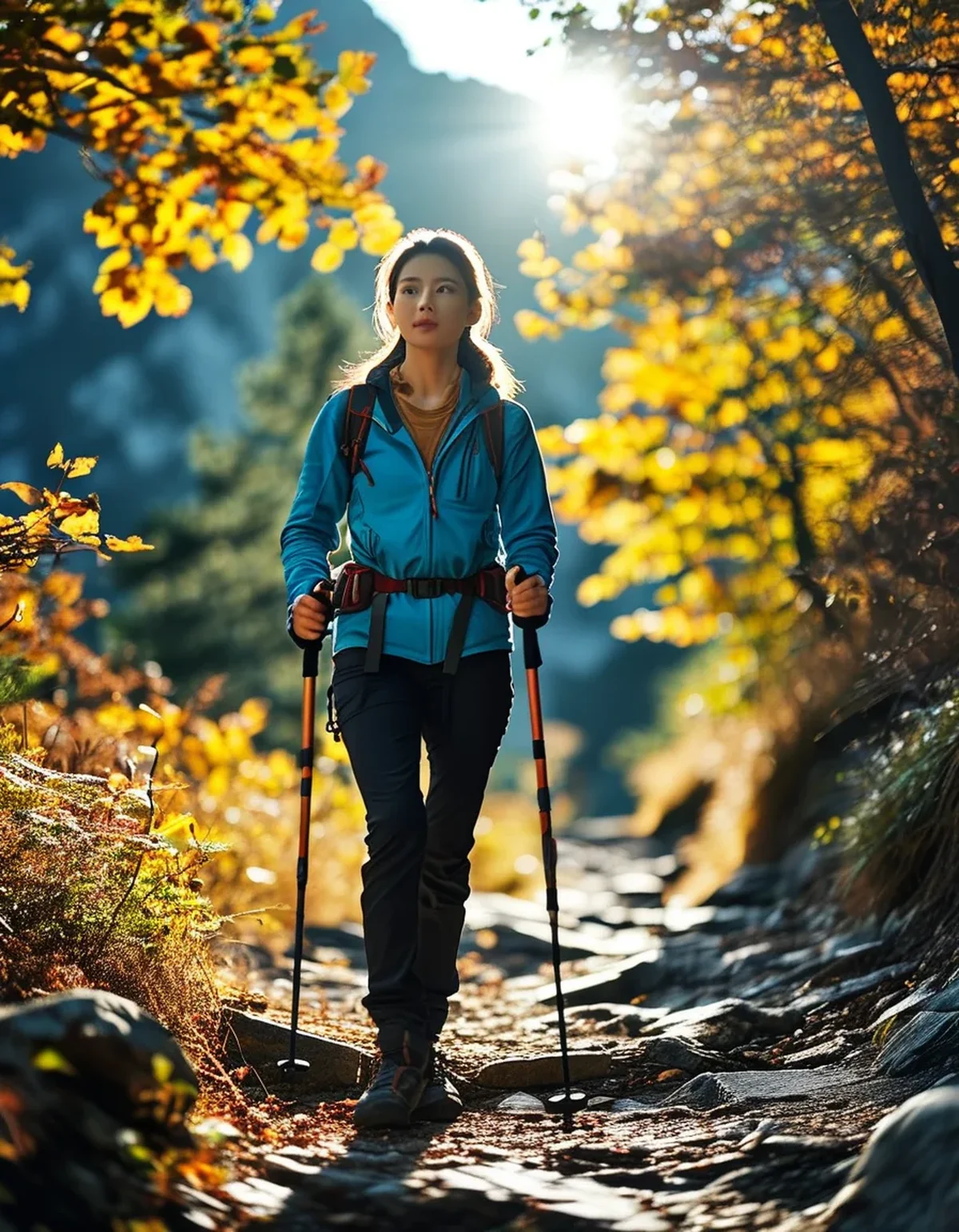
Trekking poles are the highest-value intervention available. Research consistently shows meaningful reductions in lower-limb loading with pole use on descents, and the effect is largest when you use them actively rather than as decoration.
Lengthen poles for descent by roughly 5 to 10 centimetres compared with your flat-ground setting, so you are not reaching down.
Take shorter steps. A shorter step means less drop per step and less force to absorb. It feels slower and it is dramatically kinder.
Keep a slight bend in the knee at contact. A straight-legged landing transmits force directly into the joint; a soft knee lets muscle absorb it.
Zigzag on steep sections rather than descending the fall line, which converts one steep descent into several shallow ones.
Tighten your boot laces before descending, particularly the upper hooks, which stops your foot sliding forward. Almost all descent toe pain is a lacing problem rather than a boot-size problem.
And take short breaks on long descents, which lets the quadriceps recover some absorbing capacity rather than degrading continuously.
Myth vs Fact: Hiking Loads and Soreness
Myth: uphill is the hard part. Fact: uphill is the metabolically hard part. Downhill is the mechanically hard part and the one that decides how you feel for the next two days.
Myth: soreness means you are getting fitter. Fact: soreness indicates muscle damage from eccentric work. Some adaptation follows, but severe soreness mostly indicates you did more eccentric work than you were prepared for.
Myth: trekking poles are for older or unsteady hikers. Fact: they are load-management equipment, used routinely by mountain athletes, and their biggest measurable benefit is on descent.
Myth: lighter boots are always better. Fact: on descents with a loaded pack, ankle support and a stiffer sole often reduce fatigue more than the saved weight helps. It is a genuine trade-off rather than a rule.
Myth: you cannot train descending. Fact: you can and should - repeated downhill walking is the specific stimulus that builds eccentric tolerance, and it adapts quickly. Two or three sessions produce a noticeable difference.
Myth: black toenails mean boots that are too small. Fact: usually it means the foot is sliding forward on descent, which is a lacing problem. Re-lace the upper hooks tightly before descending.
How do you train for the way down?
Walk downhill deliberately. Find a hill or a long set of stairs and descend repeatedly. Eccentric tolerance is highly trainable and adapts within a few sessions.
Add step-downs at home: stand on a step, lower one foot slowly to the floor over three seconds, return. Three sets of eight per leg, twice a week.
Build quadriceps strength generally with squats or leg press, which raises the ceiling that eccentric tolerance sits under.
The repeated bout effect is real and strong - a single hard downhill session substantially protects you against soreness from the next one for weeks. One training descent before a big hike genuinely pays.
Practise with the pack you will carry, since loaded descent is a different skill from unloaded descent.
Progress mileage by roughly 10 percent per week, and treat descent distance as the number that matters rather than total distance.
And check your gear on the training walks, because descent is where boot fit, lacing and pole length problems reveal themselves. This is general information, not medical advice.
FAQ: Hiking Descents, Answered
How heavy should my day pack be?
A common guideline is at or under about 10 percent of body weight for day hikes. Conditioning matters more than the ratio, and water is usually the biggest lever.
Do trekking poles really help?
Yes, particularly on descent, where studies consistently show reduced lower-limb loading. Lengthen them for the way down and plant them actively.
Why do my knees hurt going down but not up?
Because descent is eccentric work with much higher joint forces. Shorter steps, poles, a soft knee at contact and a lighter pack all reduce it directly.
Why do my toes hurt or bruise on descents?
Your foot is sliding forward inside the boot. Tighten the upper lacing hooks before the descent and consider a heel-lock lacing pattern.
Should I descend fast to get it over with?
No. Faster descent means higher impact forces per step and greater muscle damage. Controlled and shorter-stepped is the better trade even though it takes longer.
How long should soreness last?
Delayed-onset soreness typically peaks at 24 to 72 hours and resolves within about five days. Sharp joint pain, swelling or pain that worsens rather than improves is different and warrants medical advice.
TL;DR:
- Uphill is metabolically hard; downhill is mechanically hard, and downhill decides how you feel for two days.
- Eccentric quadriceps work plus multiples of body weight through the knee is what descent actually is.
- Every pound of pack weight is paid for on every descent step - weigh the pack at home.
- Trekking poles are the highest-value fix; lengthen them for the descent and plant them actively.
- Shorter steps, a soft knee at contact, and zigzagging on steep sections all cut joint load directly.
- Tighten the upper lacing hooks before descending - most toe pain is a lacing problem, not a sizing one.
Train the descent. Eccentric tolerance adapts fast, and one training descent protects you for weeks. This is general information, not medical advice.
Keep Reading
This article is for general informational and styling purposes only. Fit, sizing, and product availability may vary.