Why the Pace You Set in the First Mile Decides How the Whole Hike Goes
Quick Answer: Starting faster than your sustainable aerobic pace shifts your energy system toward faster-burning fuel and accumulates fatigue you cannot repay while still moving. Because the first mile is usually the freshest and often the flattest, it is the easiest place to overshoot without noticing. The talk test — full sentences comfortably — is the most reliable check, and it works from the first hundred yards.
The first mile felt great. It always does.
That is the problem, and by hour three it is not fixable.
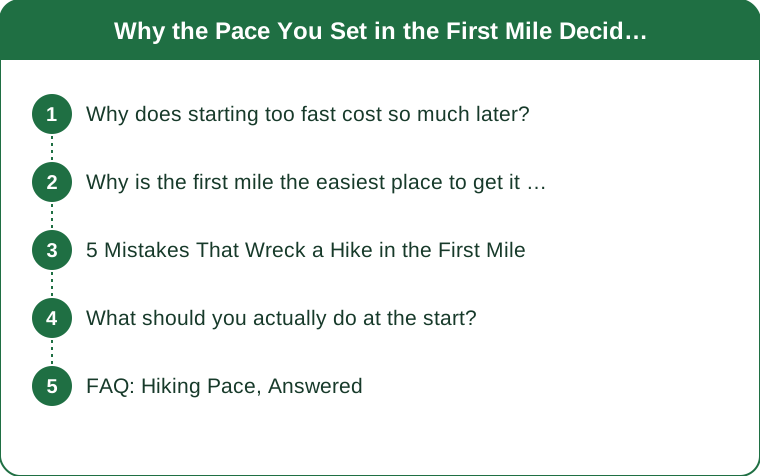
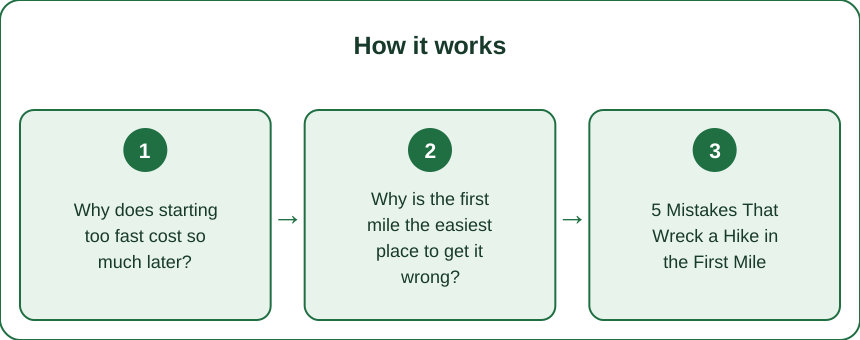
Why does starting too fast cost so much later?
Because of which fuel system you commit to in the first twenty minutes.
Below your aerobic threshold, you burn fat efficiently and sustainably. This is the pace you can hold for hours, and it is slower than most people’s instinctive starting pace.
Above it, you shift toward carbohydrate and accumulate fatigue. Carbohydrate stores are limited and the byproducts accumulate. You are spending a budget you cannot top up mid-hike.
The overshoot does not feel like anything at the time. Twenty percent above sustainable pace feels fine for the first forty minutes. The cost shows up hours later as legs that will not respond regardless of how much you slow down.
You cannot recover while still moving. Slowing down later helps, but it does not repay the deficit. This is what makes the first mile disproportionately decisive compared to any other part of the hike.
Cool autumn weather makes it worse. Cool air makes a fast pace feel comfortable, so the usual heat-based feedback that would have slowed you down in July is absent in October. Most people start faster in fall without realizing it.
Why is the first mile the easiest place to get it wrong?
Everything about it encourages a faster pace than you can hold.
You are completely fresh. No accumulated fatigue means your comfortable pace feels much faster than your sustainable one.
Trailheads are usually the flattest part. Trails commonly ease in before climbing, so the first mile gives a misleading sense of the terrain and of your pace relative to it.
Group dynamics push pace upward. In a group, the pace tends to settle near the faster members at the start, before anyone has a reason to negotiate. That is the single most common cause of a bad hike for the slowest member.
Enthusiasm at the start is real and unhelpful. Being outdoors and starting something feels good, and that feeling reliably translates into moving faster than planned.
There is no feedback for twenty minutes. By the time your body signals that this was too fast, you have already banked the cost. This is why a deliberate check beats waiting to feel something.
5 Mistakes That Wreck a Hike in the First Mile
1. Matching someone else’s pace by default. The most common and most costly. Say at the trailhead that you are setting your own pace for the first mile and will catch up at the first stop. Almost everyone is fine with this and almost nobody volunteers it.
2. Skipping the warm-up entirely. Cold muscles at a fast pace is both harder and more injury-prone. Walking the first five minutes deliberately slowly is a warm-up, and it is the cheapest performance improvement available.
3. Not eating before you start. Starting a multi-hour effort without fuel means drawing on limited stores from the first step. A carbohydrate-containing breakfast 60 to 90 minutes before changes the whole back half of the hike.
4. Drinking to thirst in cool weather. Cool air suppresses thirst while you continue losing fluid through breathing and sweat you cannot see. Autumn dehydration is common precisely because it does not feel like a hot day. Drink on a schedule instead.
5. Wearing everything you brought. Starting warm means sweating in the first mile, and damp base layers cost you significantly once you stop or reach exposure. Start slightly cold — you will be comfortable within ten minutes.
What should you actually do at the start?
One check, one rule, and one adjustment.
Use the talk test from the first hundred yards. You should be able to speak a full sentence comfortably. If you are breaking sentences to breathe, you are above your sustainable pace, and this is true regardless of what the pace looks like on paper.
Deliberately hold back for the first ten minutes. Slower than feels natural. This is a warm-up and a pace anchor, and it consistently produces a faster overall time than starting quick, because the back half does not collapse.
Check again at the first climb. Terrain changes are where pace discipline breaks. The talk test on a climb is the honest one — most people hold a sustainable pace on the flat and blow past it on the first hill.
Plan for descent cost. Descending is harder on the legs than climbing and it comes at the end, when you have the least left. A pace that leaves nothing for the descent is a pace that made the whole hike unpleasant, and this catches out more people than the climb does.
Use a time target, not a distance target. Deciding to walk for four hours removes the pressure to hit a mileage number, which is what drives most overshooting. Distance goals produce fast starts; time goals do not.
FAQ: Hiking Pace, Answered
How much slower should the first mile actually be?
Roughly 10 to 20 percent slower than the pace you intend to hold. It will feel unnecessarily easy, which is the correct sensation. If the first mile felt good rather than easy, it was probably too fast.
Does this apply to short hikes too?
Less so under about 90 minutes, where you can absorb a fast start without a real cost. The effect grows with duration, and anything over two hours is firmly in the territory where the first mile decides how the last one feels.
Why are autumn hikes slower than the same trail in summer?
Wet leaves reduce traction and require more stabilizing work, daylight is shorter so there is time pressure, and cooler air masks exertion. The same trail routinely takes longer in October, which is worth planning for rather than being surprised by.
TL;DR:
- Starting above your aerobic threshold spends a fuel budget you cannot repay while moving
- The first mile is the freshest and usually the flattest, which makes overshooting almost automatic
- Use the talk test from the first hundred yards, and re-check on the first climb
- Say out loud at the trailhead that you are setting your own pace — group default pace is the main culprit
- Use a time target rather than a distance target, and save something for the descent
Holding back at the start feels like giving something up, and it is the opposite — the hikers who finish comfortably are almost always the ones who looked slow in the first mile.
Keep Reading
This article is for general informational and styling purposes only. Fit, sizing, and product availability may vary.