Why the Last Mile of a Hike Is Where Most Injuries Happen
Quick Answer: By the final stretch of a hike, three things have changed at once: the stabilising muscles around your ankles and knees are fatigued, your attention has dropped because the effort feels finished, and you are usually descending — which loads the body eccentrically and is where most trail injuries occur. Add reduced foot lift from tired hip flexors and the classic trip becomes likely. The last mile deserves the most attention of the whole hike, and it reliably gets the least.
It is a genuinely well-recognised pattern among people who spend time on trails.
And nearly all of it is manageable if you know what is happening.
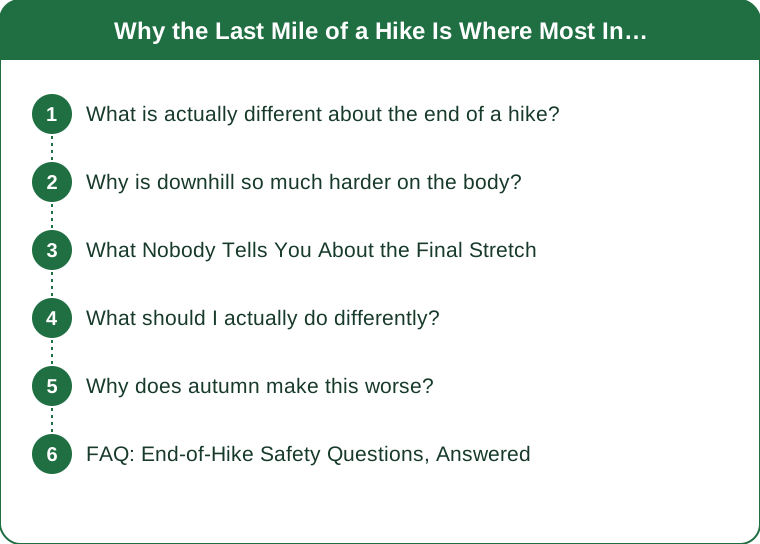
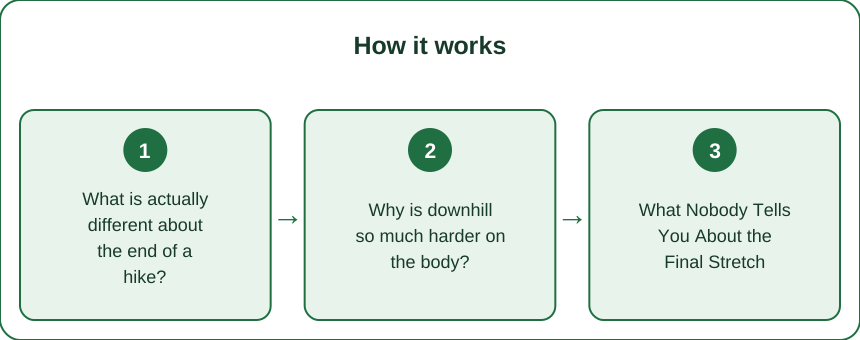
What is actually different about the end of a hike?
Four things, and they arrive together.
Stabiliser fatigue. The small muscles around the ankle and knee that respond to uneven ground work continuously on a trail, making constant micro-adjustments. They fatigue before the large muscles do, and when they do, your ability to correct a foot landing badly is measurably reduced. The trip happens the same way it would have at mile two; the recovery does not.
Reduced foot clearance. Tired hip flexors lift the foot slightly less with each step. The difference is a couple of centimetres and it is exactly the height of the root you catch. This is the single most common mechanism of the late-hike trip.
Attention drops. Once the summit is behind you and the end is in sight, the psychological effort ends before the physical one does. People stop reading the trail, start talking, start thinking about the drive home. The trail is not easier; you are just watching it less.
Descending. Most hikes end going downhill, and descent is where the majority of hiking injuries occur. Downhill walking loads muscles eccentrically — lengthening under tension — which produces more muscle damage, more force through the knee, and greater demand on control. Ground reaction forces going downhill are considerably higher than on the flat.
Add anything else that is often true at the end — low blood sugar, dehydration, fading light, wet ground — and the risk profile of the last mile looks nothing like the rest of the walk.
Is this really that common?
It is a widely recognised pattern among hikers and mountain rescue teams, who consistently report descent and the latter part of a day as high-risk. The mechanisms above are well understood individually.
Why is downhill so much harder on the body?
Because of the type of muscle contraction involved, and it is worth understanding rather than just enduring.
Going uphill, muscles shorten as they contract — concentric work. It is metabolically demanding, your heart rate rises, and it feels hard. It causes relatively little muscle damage.
Going downhill, muscles lengthen while contracting — eccentric work. Your quadriceps are acting as brakes on every step, controlling the descent of your body weight. Eccentric contraction produces considerably more muscle damage than concentric for the same amount of work, which is why the day after a hike your quads hurt from the descent rather than the climb.
It also feels easier while you are doing it, because it is far less demanding on the cardiovascular system. The mismatch between how it feels and what it costs is the trap.
The forces involved:
- Ground reaction forces increase on descent, and increase further with speed and with steepness.
- Knee joint loading rises substantially, which is why descending is where knee pain shows up.
- Each step involves a controlled fall, absorbed by the leg — thousands of times over a long descent.
What reduces it:
- Shorter steps. The single most effective change. A short step means a smaller drop to absorb, and much less force.
- Slightly bent knees, always. A straight leg transmits force to the joint rather than absorbing it in muscle.
- Trekking poles, which have been shown to meaningfully reduce loading on the legs during descent. For anyone with knee concerns, these are the highest-value piece of equipment available.
- Zig-zagging on steep sections rather than going straight down.
- Landing on the whole foot rather than the heel where the ground allows.
What Nobody Tells You About the Final Stretch
Fuel matters at the end, not the start. People eat well before and during the first half and then stop, because the end is near. Low blood sugar directly degrades coordination and decision-making, and it arrives at exactly the wrong moment. Eat something in the last hour even if you do not feel like it.
Poles are for going down, not going up. Most people who own poles use them on the climb and put them away for the descent, which is precisely backwards. The descent is where they do the most good.
Loosen your boot laces going down, but tighten the ankle. A specific technique: keep the forefoot section slightly looser to let the foot spread, and tighten across the ankle to stop the foot sliding forward into the toe box. This is what prevents black toenails, and most people have never been shown it.
Your pack should be tightest at the end. A loose pack shifts with each step, and that shifting load is what pulls you off balance when your stabilisers are already tired. Cinch it down before the descent.
The last mile is where people take photos, check phones, and stop looking at the trail. Watching the ground for the final stretch is worth more than watching it anywhere else.
Talking is fine; walking side by side on uneven ground is not. Most late-hike trips happen when people are looking at each other rather than at the trail. Single file for the technical bits.
And the least obvious one: cold arrives during the descent. You have stopped climbing, so you are generating less heat, and you are usually losing altitude into the shade as the sun gets lower. Put a layer on before you feel cold, because cold muscle is less responsive and cold fingers cannot use poles properly.
What should I actually do differently?
A short protocol for the last third of any hike.
Before you start descending:
- Eat something. Even a small amount.
- Drink. Dehydration degrades coordination as much as it degrades endurance.
- Adjust your boots — tighter at the ankle, slightly looser at the forefoot.
- Tighten your pack.
- Get your poles out, lengthened slightly for the descent.
- Add a layer before you cool down.
During the descent:
- Shorten your stride deliberately. This is the highest-value change and it is free.
- Keep a small bend in the knees at all times.
- Slow down. Speed multiplies force and reduces reaction time.
- Look several steps ahead rather than at your feet, so you plan rather than react.
- Single file on anything uneven.
- Take a genuine break if the descent is long — the fatigue is cumulative and a five-minute stop resets a surprising amount.
And the mental version, which is the important one: treat the last mile as the beginning of a new hike, not the end of the current one. The people who get hurt are the ones who mentally finished at the summit.
If you have knee problems, a previous ankle injury, or balance concerns, poles and shorter days are both worth prioritising. This is general information, not medical advice.
Why does autumn make this worse?
Because nearly every factor moves in the wrong direction at once, and it starts now.
Wet leaves are genuinely slippery, particularly on rock, roots and wooden boardwalks. A leaf-covered trail also hides the surface underneath — you cannot see the root, the hole or the loose stone. This is the single biggest seasonal hazard, and it arrives over the next few weeks.
Daylight is contracting fast. Around the equinox, day length shortens at close to its maximum rate. A route that finished comfortably in daylight in August finishes in dusk in October. Descending in fading light removes exactly the visual information you need most, and depth perception is the first thing to go.
Ground gets wetter and stays wet. Mud that dried within a day in July persists for a week in October. Trails become more technical without changing at all.
Temperatures drop during the descent, and the difference between the ridge in the sun and the valley in the shade is substantial. Cold muscle responds more slowly, and cold hands lose grip on poles.
And the ends of hikes happen in lower sun angles, which produces genuine glare on wet ground and long shadows that hide obstacles.
What to do over the next several weeks:
- Turn around earlier than you would have in summer. Work back from sunset with an hour of buffer, and treat that as a hard limit.
- Carry a head torch on every autumn hike, even short ones. It weighs nothing and it is the difference between an inconvenience and an incident.
- Assume leaf-covered ground is slippery and hiding something, and shorten your stride accordingly.
- Take poles, even on routes where you would not have in summer.
- Add the layer earlier, before the descent rather than during it.
- Check the forecast for the valley, not just the summit, since that is where you will be at the end.
Should I change my route choices in autumn?
Worth favouring routes where the descent is on a good path rather than on rock or roots, and where the final section is easy walking. Saving the technical ground for when you are fresh is sound planning at any time of year and it matters most now.
FAQ: End-of-Hike Safety Questions, Answered
Do trekking poles really help that much?
On descent, yes — they reduce loading on the legs and provide two extra points of contact for balance. They are the highest-value item for anyone with knee concerns.
Why do my toes hurt going downhill?
Your foot is sliding forward into the toe box. Tighten the lacing across the ankle to hold the heel back, and keep toenails short.
Is it better to go down fast to get it over with?
No. Speed increases force, reduces reaction time, and is a direct contributor to falls.
Should I stretch at the end?
Gentle movement helps. The main determinant of next-day soreness is the eccentric load of the descent, which stretching does not undo.
How do I know when to turn back?
Work backwards from sunset with an hour of margin, and factor in that descent is often slower than people plan for, particularly when tired.
Does fitness prevent this?
It delays the fatigue and does not remove the pattern. Fitter hikers simply go further before the same mechanisms apply.
TL;DR:
- By the last mile, ankle and knee stabilisers are fatigued, foot clearance drops by a couple of centimetres, and attention has already finished.
- Descent is where most hiking injuries happen — eccentric loading, higher ground forces, and greater control demand.
- Shorten your stride on the descent. It is the single most effective and cheapest change.
- Poles are for going down, not up, and they meaningfully reduce leg loading.
- Tighten at the ankle, loosen at the forefoot, and cinch your pack before descending.
- Eat and add a layer before the descent, not during it.
- Autumn brings wet leaves hiding the surface, fast-shortening daylight and colder valleys — carry a head torch on every hike and turn back earlier.
This is general information, not medical advice.
Treat the last mile as the start of a new hike. The people who get hurt are the ones who finished at the summit.
Keep Reading
This article is for general informational and styling purposes only. Fit, sizing, and product availability may vary.