Why You Drink Less on Cool Trails - and Why That Backfires
Quick Answer: Cool air blunts thirst, and you lose a large amount of fluid through your breath and through sweat that evaporates before you ever feel wet. So on a cool trail you feel less thirsty while losing a comparable amount of water - and you drink less exactly when you needed the same amount. The result usually shows up as late-hike fatigue, heavy legs, and a headache, which almost everyone blames on the climb instead of on hydration.
Here is why the cue fails, and how to drink on a schedule rather than on feel.
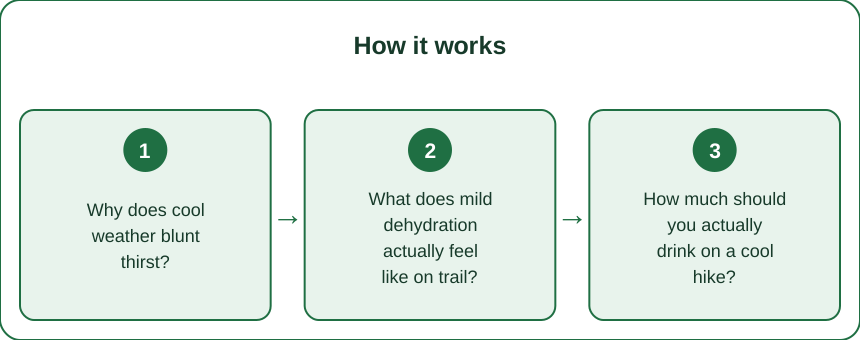
Why does cool weather blunt thirst?
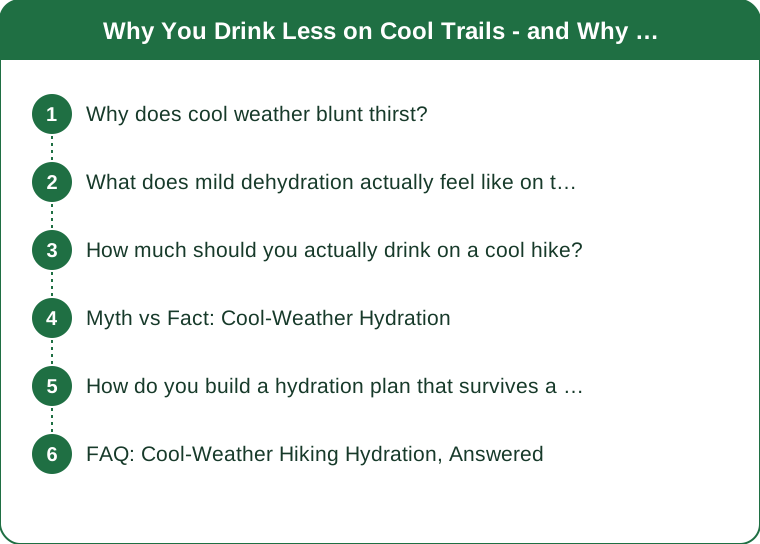
Two mechanisms, both well documented.
Cold triggers peripheral vasoconstriction. Blood vessels near the skin narrow to conserve heat, which shifts blood volume toward the core. Your body reads the increased central blood volume as ‘well hydrated’ and suppresses thirst signalling - even though total body water may be dropping.
And you get no sweat feedback. In hot weather, visible sweat is a constant, obvious reminder. In cool, dry air, sweat evaporates the moment it forms - so you stay dry and receive none of the sensory cues that normally prompt drinking. You are losing fluid without any evidence of it.
Respiratory loss rises in cold air too. Every breath humidifies the air you inhale, and cold air is dry, so it takes more moisture from you per breath. Breathing hard on a climb in cool, dry air is a meaningful and completely invisible route of fluid loss.
Cold also increases urine production - cold-induced diuresis, driven by the same central blood volume shift. So you are losing more through one route while feeling less inclined to replace it.
Put together: lower intake, comparable or higher losses. The deficit accumulates quietly over hours, which is precisely why it shows up at the end of a hike rather than the beginning.
What does mild dehydration actually feel like on trail?
Rarely thirst. That is the whole problem.
Fatigue that seems out of proportion to the effort. The most common presentation. You are slower than usual on terrain you have handled before, and it feels like a fitness issue.
Heavy legs, especially on the descent. Coordination and muscular endurance both degrade, and descending demands more control than climbing does, so it surfaces there first.
Headache, often frontal, often appearing late. Extremely common and almost universally blamed on sun, altitude, or effort.
Reduced concentration and slower decision-making. This is the safety-relevant one - navigation errors and missed footing rise with even mild dehydration, and you are least likely to notice a cognitive change from the inside.
Cramping is a possible sign but an unreliable one. Cramp has multiple causes and does not reliably indicate dehydration.
Dark urine is the most practical check available. Pale straw is the target. Dark yellow or amber means you are behind, and the check costs nothing.
And the timing pattern is diagnostic in itself: a hike that feels fine for three hours and falls apart in the fourth is a much stronger signal of accumulated fluid deficit than of sudden fatigue.
How much should you actually drink on a cool hike?
A workable starting framework, adjusted by how you actually feel.
A common general guideline for hiking is roughly half a litre (about 17oz) per hour of moderate activity, adjusted up for heat, effort, altitude, and body size. Cool weather does not reduce this as much as it feels like it should - plan for something close to your warm-weather rate rather than half of it.
Body size matters and is usually under-accounted for. Larger bodies generate more metabolic heat and carry more total water, so absolute fluid needs are higher, not the same. Guidance written around a smaller default body underestimates it.
Drink on a schedule, not on thirst. A few good mouthfuls every 15 to 20 minutes works far better than waiting for a signal that cold weather has switched off. Set a watch reminder if you tend to forget.
Start hydrated. Fluid taken in the hours before the hike is worth more than anything you do to catch up mid-trail. Arriving at the trailhead already behind is a very common and entirely avoidable error.
Include electrolytes on longer or harder days. Sweat contains sodium, and plain water alone over many hours can dilute blood sodium - rare, but genuinely dangerous. Any hike over roughly two to three hours, or any hike where you are sweating steadily, is worth adding electrolytes to.
Warm fluid gets consumed more readily in the cold. A thermos of tea or warm electrolyte drink materially increases how much people actually drink on cool hikes, purely because it is more appealing. This is a genuinely effective trick rather than a comfort item.
And a bladder beats a bottle for compliance. A hose on your shoulder strap gets used; a bottle in a pack that requires stopping and taking the pack off does not. Convenience is most of the battle.
Myth vs Fact: Cool-Weather Hydration
Myth: You only need to worry about dehydration in hot weather. Fact: Fluid losses in cool weather are frequently comparable, because respiratory loss rises in cold dry air, cold increases urine production, and sweat still occurs - it just evaporates invisibly. The losses stay; only the feedback disappears.
Myth: If you were dehydrated, you would be thirsty. Fact: Cold actively suppresses thirst through the central blood volume shift. Thirst is an unreliable indicator in cool conditions specifically - which is why scheduled drinking exists.
Myth: You sweat much less when it is cool. Fact: You sweat less at rest, but under load on a climb - especially wearing layers - you can sweat substantially and never feel it, because it evaporates immediately. Layers that trap moisture make this worse, not better.
Myth: Drinking more water is always safer. Fact: Very large volumes of plain water over many hours without electrolytes can dilute blood sodium. It is uncommon, but it is serious, and it is why longer efforts warrant electrolytes rather than just more water.
Myth: Coffee before a hike dehydrates you. Fact: Moderate caffeine intake in habitual coffee drinkers has a modest diuretic effect that is largely offset by the fluid in the drink. Your morning coffee is not the problem - not drinking anything after it is.
The one that surprises people: you can be meaningfully dehydrated while feeling cold and comfortable. Comfort is not evidence of hydration, and on a cool trail those two feelings decouple almost completely.
How do you build a hydration plan that survives a cool day?
Practical, and mostly about removing friction.
Pre-hydrate the evening before and the morning of. Aim for pale urine before you leave. This is the single highest-value step and it costs nothing on the trail.
Carry a bladder with the hose accessible, or bottles in side pockets you can reach without removing the pack. Any system that requires stopping will be used less.
Bring a thermos of something warm on cool days. Tea, warm electrolyte drink, or broth. You will drink more of it than of cold water - this is consistently true and worth the weight.
Set a timer for the first hour. Once the habit is established for the day it usually continues. The first hour is when the cold-suppressed thirst does the most damage.
Add electrolytes for anything over two to three hours. Tablets or powder are light and take up no space.
Check urine colour at the first stop. Pale straw is fine; dark means catch up gradually, not all at once.
Plan a drink at every layer change. Layer changes are natural stops on cool hikes, and pairing the two habits means you never go a long stretch without drinking.
Eat as well as drink. Food contains water and provides the sodium that helps you retain it. Long cool hikes where people stop eating are frequently the ones that end badly.
If you experience confusion, dizziness, fainting, a rapid heart rate, or you stop urinating, treat that as more than mild dehydration and seek medical attention - and be aware that nausea with a headache after drinking a lot of plain water over many hours can indicate low blood sodium, which needs medical assessment rather than more water. This is general information, not medical advice.
FAQ: Cool-Weather Hiking Hydration, Answered
Do I really need as much water when it is cool?
Usually much closer to your warm-weather amount than it feels. Respiratory losses rise in cold dry air, cold increases urine output, and sweat still happens - it just evaporates before you notice it.
How much per hour is a reasonable starting point?
Roughly half a litre (about 17oz) per hour of moderate hiking is a common general guideline, adjusted up for effort, altitude, and body size. Larger bodies generally need more, not the same.
Why am I not thirsty?
Cold causes blood to shift toward your core, and your body reads that as being well hydrated, which suppresses thirst signalling. It is a genuine physiological effect, not a lack of attention.
Do I need electrolytes or is water enough?
Water is fine for short hikes. For anything beyond roughly two to three hours, or when sweating steadily, electrolytes help you retain fluid and reduce the risk of diluting blood sodium.
What is the easiest way to actually drink more?
A hydration bladder with the hose on your shoulder strap, and a thermos of something warm. Both work by removing friction rather than by requiring discipline.
How do I know if I am behind?
Urine colour is the most practical field check - pale straw is the target. Unexplained late-hike fatigue, heavy legs on the descent, and a frontal headache are the classic pattern of accumulated deficit.
TL;DR:
- Cold suppresses thirst by shifting blood toward your core - so the cue you rely on stops working exactly when you still need fluid.
- Sweat evaporates invisibly in cool dry air, removing the feedback that normally prompts you to drink.
- Respiratory loss rises in cold air and cold increases urine output - two invisible losses stacked together.
- Plan for close to your warm-weather intake, roughly half a litre an hour, adjusted up for body size and effort.
- Drink on a schedule - a few mouthfuls every 15 to 20 minutes - rather than waiting for thirst.
- A warm thermos and an accessible hose increase actual intake more than any amount of good intention.
- Add electrolytes past two to three hours, and check urine colour at the first stop.
The hike that falls apart in the last mile is usually a hydration story, not a fitness one.
This is general information, not medical advice.
Keep Reading
This article is for general informational and styling purposes only. Fit, sizing, and product availability may vary.