Why Trail Mileage Time Estimates Run Short for Plus-Size Hikers Specifically
Quick Answer: Standard trail time estimates are typically calculated using a generic average pace formula (commonly around 2-3 miles per hour on flat terrain, adjusted for elevation gain) that doesn’t account for individual differences in stride length, body composition, or terrain-specific energy demands — meaning the estimate is a rough average baseline, not a personalized prediction, and running slower than it doesn’t reflect an individual fitness shortfall.
The sign says three hours. It takes four. That gap isn’t a personal fitness failure — it’s a mismatch with how generic the underlying estimate actually is.

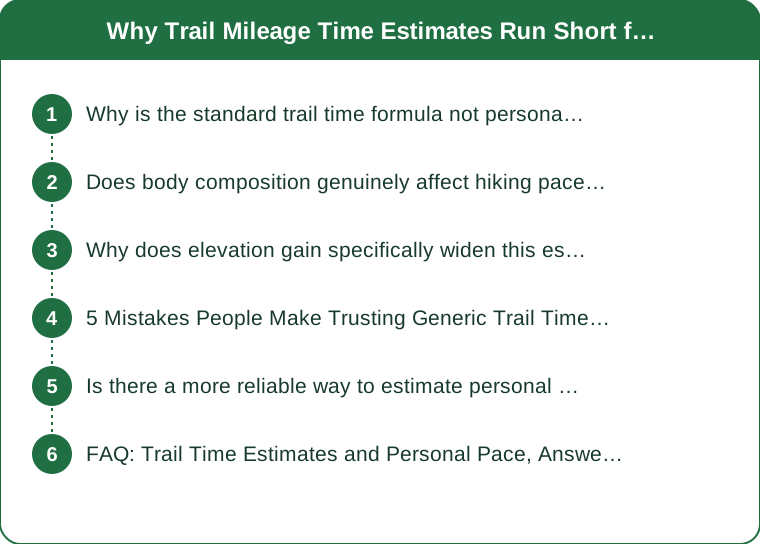
Why is the standard trail time formula not personalized to begin with?
Most posted trail estimates use a long-established general hiking pace formula (like Naismith’s Rule, roughly 3 miles per hour plus extra time per elevation gain) developed as a broad average across a wide range of hikers and conditions, meaning it was never designed to reflect any individual hiker’s actual pace, body type, or specific terrain experience — it’s a rough planning baseline, not a personal benchmark.
Does body composition genuinely affect hiking pace on identical terrain in a measurable way?
Yes — body composition affects factors like power-to-weight ratio on inclines and overall energy expenditure per mile, meaning two hikers with identical cardiovascular fitness levels but different body compositions can have genuinely different sustainable paces on the same trail, independent of effort or training level.
Why does elevation gain specifically widen this estimate gap more than flat terrain does?
Generic elevation-adjustment formulas add a fixed time penalty per elevation gained regardless of hiker-specific factors, but the actual energy cost of climbing scales with body weight more directly than flat-terrain walking does, meaning the gap between a generic estimate and an individual’s actual pace tends to widen specifically on steeper sections rather than staying constant across an entire trail.

5 Mistakes People Make Trusting Generic Trail Time Estimates
Treating the posted estimate as a hard deadline rather than a rough baseline, not accounting for personal pace data from past hikes when planning a new one, underestimating water and food needs based on the shorter estimated time rather than a realistic personal time, starting a hike too late in the day based on a faster-than-actual estimate, and not building in buffer time for photo stops or breaks all compound the basic estimate-mismatch problem into real planning risk.
Is there a more reliable way to estimate personal trail time than the generic posted number?
Tracking actual pace on a few known trails using a GPS watch or hiking app, then applying that personal pace-per-mile-plus-elevation figure to a new trail’s stats, produces a meaningfully more accurate personal time estimate than relying on the generic posted number alone.
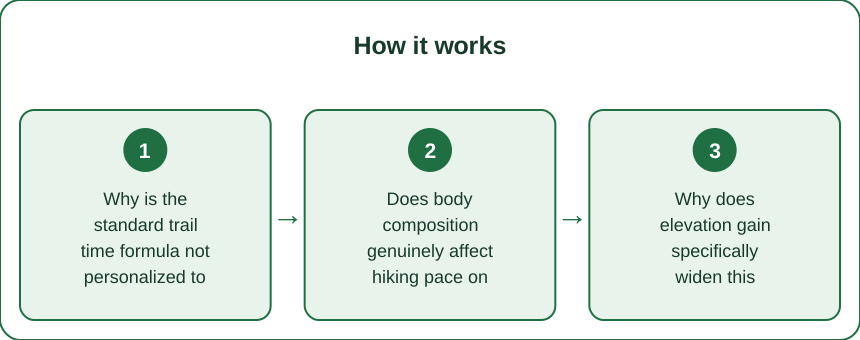
FAQ: Trail Time Estimates and Personal Pace, Answered
Should posted trail estimates be ignored entirely in favor of personal pace tracking?
Not entirely — they’re still useful as a rough starting baseline, especially for unfamiliar trails, but should be adjusted using personal pace data rather than trusted as an exact prediction.
Does trekking pole use meaningfully change actual hiking pace compared to the generic estimate?
For many hikers, yes — trekking poles can improve pace and reduce fatigue on both inclines and declines, meaning consistent trekking pole users may find their personal pace closer to or even faster than generic estimates in some cases.
How much extra buffer time is reasonable to add to a generic trail estimate for planning purposes?
A common practical approach is adding 25-50% extra time to a generic estimate until enough personal pace data exists to calculate a more accurate individual figure for future trips.
TL;DR:
- Standard trail time estimates use a generic average formula, not a personalized prediction for any individual hiker
- Body composition genuinely affects sustainable pace on identical terrain, independent of fitness or effort level
- Elevation gain widens the estimate-versus-actual-pace gap more than flat terrain does
- Tracking personal pace on known trails and applying it to new ones beats trusting the generic posted number alone
Running slower than a posted trail estimate isn’t a fitness verdict — it’s a generic formula meeting real individual variation, and personal pace tracking closes that gap far better than the sign ever will.
Keep Reading
This article is for general informational and styling purposes only. Fit, sizing, and product availability may vary.