Why Trail Layering Fails on the First Cold Descent
Quick Answer: You get cold on the descent because you sweated on the climb and then stopped producing heat. A damp base layer pulls heat from your body many times faster than a dry one, and going downhill generates far less warmth than going up. The fix is to manage the climb, not the descent: start cold, vent early and often, and never let yourself sweat through the layer against your skin. Add insulation at the top before you get cold, not after.
The most common trail mistake is dressing for the temperature at the trailhead.
Here is the sequence that actually works.

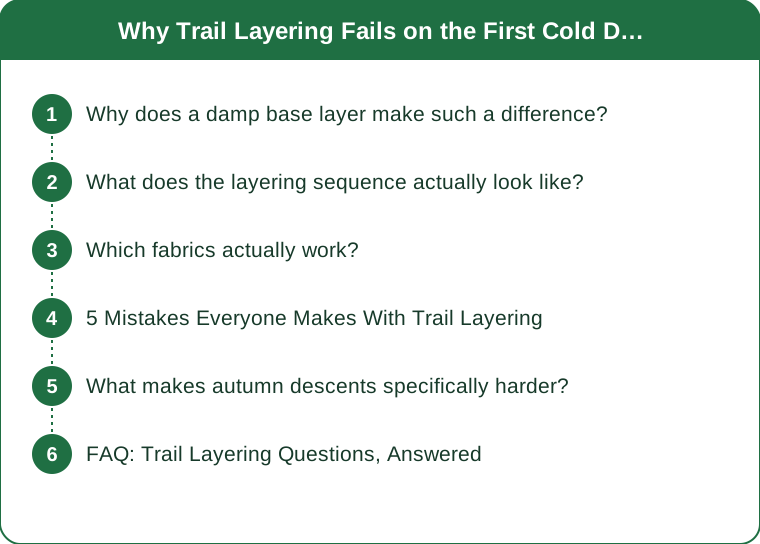
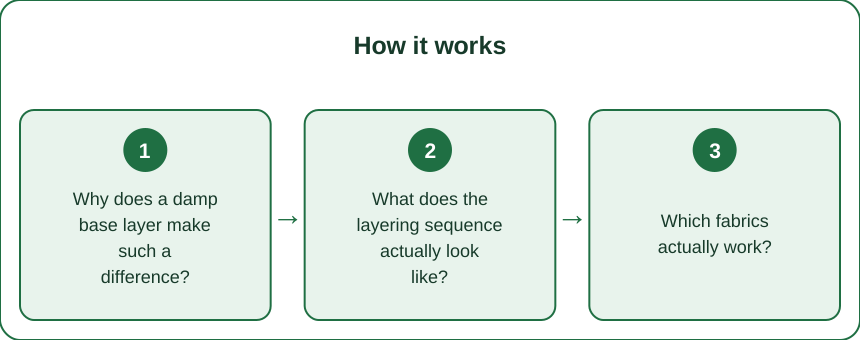
Why does a damp base layer make such a difference?
Because water moves heat away from you far more effectively than air does.
Wet fabric against the skin conducts heat away at a dramatically higher rate than dry fabric. Once your base layer is soaked, you are effectively wearing a cooling system.
And the descent removes your heat source. Going uphill generates a great deal of metabolic heat; going downhill generates far less - it is largely braking work, which is demanding on the muscles but produces much less warmth.
So the sequence is: climb hard, sweat, reach the top, stop for a view, start down, and the heat production drops while the wet layer keeps working.
Cotton is the worst case by a wide margin. It absorbs a great deal of water, holds it against the skin, and dries very slowly. The mountain-safety saying that cotton kills exists for exactly this mechanism.
Wind multiplies it. Ridgelines and exposed descents are windier than sheltered climbs, and wind over damp fabric accelerates heat loss substantially. The top of a climb is frequently the windiest point of the day, which is precisely where you stop moving.
What does the layering sequence actually look like?
Five steps, and the first one feels wrong.
1. Start cold. At the trailhead you should feel slightly underdressed - cool enough to want to start moving. If you are comfortable standing still at the car, you are overdressed for the climb and you will sweat within fifteen minutes. This single habit prevents most of the problem.
2. Vent before you sweat, not after. Open the pit zips, unzip the front, push the sleeves up, remove the hat. Once you are damp, venting cannot undo it. Do it at the first sign of warmth.
3. Stop and remove a layer if venting is not enough. Two minutes of stopping is worth an hour of being cold later. People avoid this because it feels like an interruption, and it is the single most valuable interruption of the day.
4. Add insulation at the top before you cool down. As soon as you stop for the summit or a break, put a layer on immediately - within a minute, not after you notice the chill. Warming a body that has already cooled is much harder than keeping it warm.
5. Add a wind layer for the descent. Even a very light shell dramatically reduces heat loss over damp clothing, and it packs down to nothing.
And carry a dry spare base layer on cold-weather days. Swapping the wet shirt at the summit is the single most effective thing you can do for a cold descent, and it takes ninety seconds.
Which fabrics actually work?
Two work, one does not, and the differences are practical rather than theoretical.
Merino wool. Insulates reasonably even when damp, resists odor well, and feels less clammy than synthetics. The trade is slower drying and higher cost, and it is less durable.
Synthetic base layers - polyester or polypropylene. Dry fastest, wick well, and are cheap and durable. The trade is odor retention, which is genuine but not a safety issue.
Cotton. Avoid against the skin in any conditions where getting cold is possible. This includes ordinary cotton t-shirts, which is what most people wear on a casual autumn hike.
Then the layers over it:
Mid layer: fleece or a light insulated jacket. Its job is warmth when stopped. It does not need to breathe well if you are taking it off for the climb, which you should be.
Shell: wind and water resistance. A wind shell earns its place more often than a full rain jacket on autumn day hikes - it weighs almost nothing and it is what makes a damp descent survivable.
And do not forget the extremities. A thin hat and light gloves take almost no space and make a disproportionate difference on a cold descent, because you lose significant heat through the head and hands and they are the first parts to feel it.

5 Mistakes Everyone Makes With Trail Layering
1. Dressing for the trailhead temperature. The trailhead is usually the warmest, most sheltered, lowest point of the day. Temperature commonly drops several degrees per thousand feet of elevation, and the summit is windier.
2. Waiting until you are cold to add a layer. Reactive layering is always behind. Add at the transition - the moment you stop climbing - not at the moment you notice cold.
3. Wearing the rain shell as a wind layer while climbing. A waterproof shell traps moisture during high exertion, so you sweat inside your own protection and arrive at the top wet from the inside. Vent it or take it off going up.
4. Carrying no spare base layer. It weighs a few ounces. On a cold day it is the difference between a pleasant descent and a genuinely bad one, and on a long day it is a safety item.
5. Not testing the system before it matters. A shakedown hike on a cool day tells you what you actually need - which is different for every person and every metabolism. Do it on a short trail near home, not on the big day out.
What makes autumn descents specifically harder?
Several factors stack, and the season is when this failure mode is most common.
The temperature swing across a day is largest in autumn. A morning that starts near freezing can reach the sixties by midday and drop fast in the afternoon. A single layering choice cannot cover that range - the system has to change during the hike.
Daylight ends abruptly and earlier than expected. Sunset comes noticeably earlier each week from September onward, and temperature drops quickly once the sun is off the slope. A descent that starts at 4 p.m. in September finishes in very different conditions than one at 4 p.m. in July.
Descents already take longer than people plan for, and a slower descent means more time producing less heat. The combination of a slow descent and falling light is the classic autumn cold-out scenario.
Wet leaves make footing slower and more careful, which reduces pace further and reduces heat production with it.
And the summit wind picks up seasonally. Autumn brings stronger and more variable winds at elevation, and the exposed viewpoint where you stop to rest is the coldest place on the route.
Practical response: turn around earlier than feels necessary, put a layer on before the view rather than after, and carry a headlamp from September onward regardless of the plan.
FAQ: Trail Layering Questions, Answered
How cold should I feel at the start?
Cool enough that you want to start walking - roughly the sensation of standing outside in a light shirt on a brisk morning. You should warm up within ten minutes of moving.
Is a puffy jacket useful if it gets wet?
Down loses most of its insulation when wet; synthetic insulation retains considerably more. For damp autumn conditions, synthetic is the safer choice, and either works if kept dry in a pack until you stop.
What if I sweat heavily no matter what I do?
Then the spare base layer becomes essential rather than optional, and wear a synthetic that dries fast rather than merino. Vent aggressively and accept that you will change shirts at the top - it is a workable plan, not a failure.
TL;DR:
- A damp base layer pulls heat away far faster than a dry one, and descents produce much less warmth than climbs.
- Start cold. If you are comfortable standing at the trailhead, you are overdressed for the climb.
- Vent before you sweat - once you are damp, venting cannot fix it.
- Add insulation the moment you stop climbing, not when you feel cold.
- Carry a spare base layer and a light wind shell. Both are ounces; both change the whole descent.
- In autumn, expect bigger swings, earlier darkness, and slower descents - and carry a headlamp.
Put a dry shirt in your pack for the next hike. Ninety seconds at the summit is the cheapest comfort you will ever buy on a trail.
Keep Reading
This article is for general informational and styling purposes only. Fit, sizing, and product availability may vary.