Why the Descent Is Harder Than the Climb for Plus-Size Hikers
Quick Answer: Descending loads your quads eccentrically — lengthening under tension to brake each step — and eccentric loading produces far more muscle damage than the concentric work of climbing. Impact forces on descent also run several times body weight per step, which is why the way down often hurts more than the way up and why the soreness arrives two days later.
Everyone budgets for the climb. Nobody budgets for the part where you’re already tired, gravity is helping, and somehow your legs are shaking harder than they did going up.
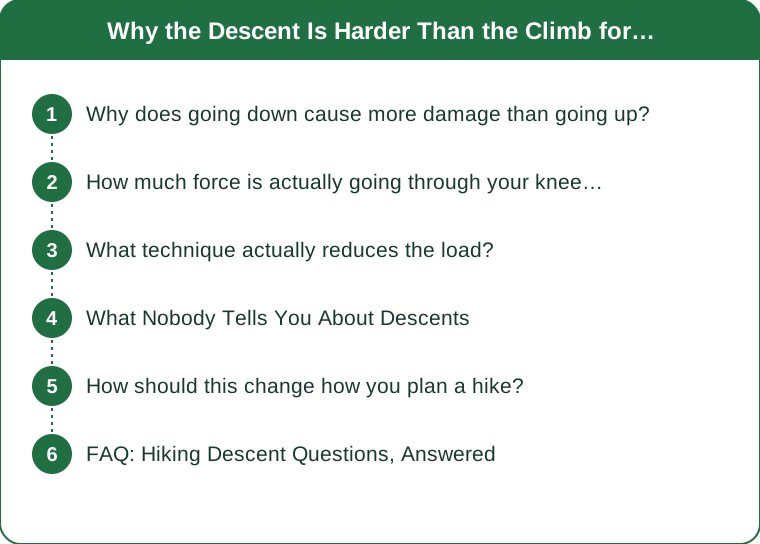
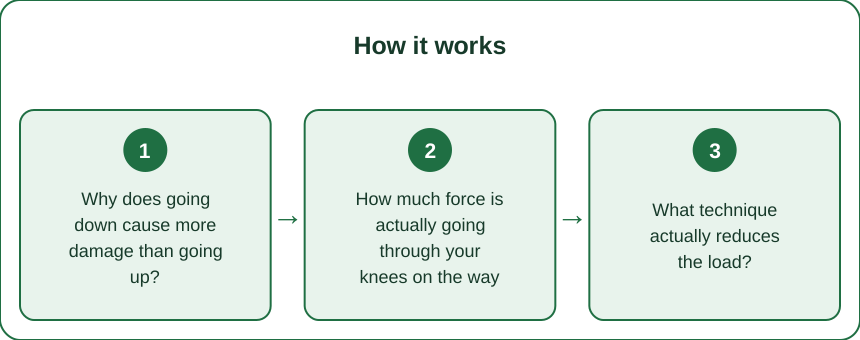
Why does going down cause more damage than going up?
Climbing is mostly concentric work — muscles shortening as they produce force. Descending is mostly eccentric — muscles lengthening while resisting, acting as brakes on every single step.
Eccentric contractions generate more force per unit of muscle activation and cause substantially more microdamage to muscle fibers. That’s the mechanism behind delayed onset soreness, and it’s why the day-after-tomorrow leg soreness from a hike traces almost entirely to the descent, not the climb.
How much force is actually going through your knees on the way down?
Impact forces during downhill walking are commonly cited in the range of several times body weight per step, depending on slope, speed, and surface. That force scales directly with total loaded weight — body plus pack.
This is the honest, unavoidable math, and it’s precisely why descent technique and equipment choices carry more leverage for plus-size hikers than any uphill strategy. The single highest-return decision on a hike is often trekking poles, which research has associated with meaningful reductions in lower-limb loading on descent.
What technique actually reduces the load?
Shorter steps. This is the whole technique in two words, and it’s the one most people get wrong when they’re tired and want to be done.
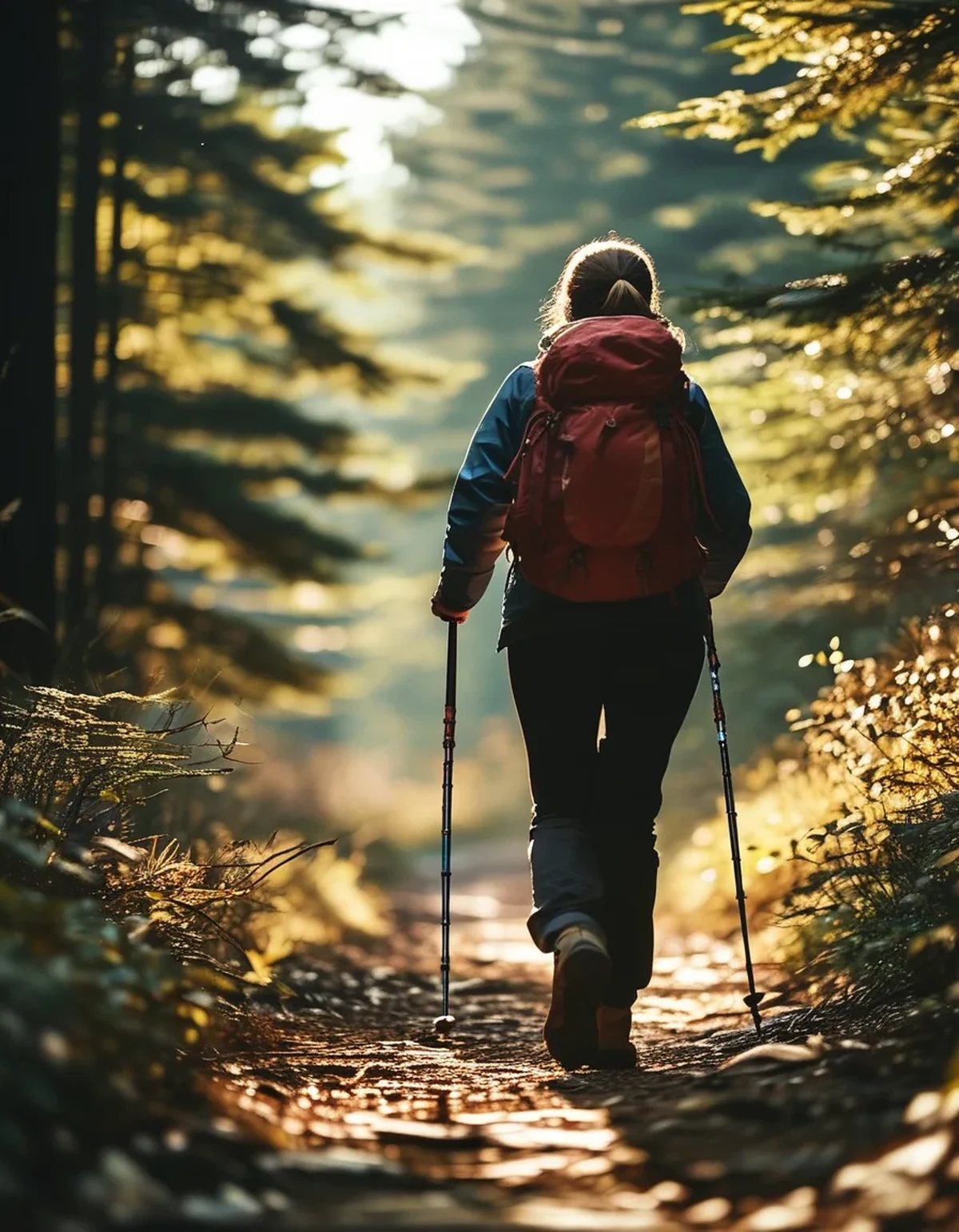
A long downhill stride means landing with a straighter leg and absorbing more force through the joint rather than the muscle. Shorten the stride, keep a soft bend in the knee, and let the foot land closer under your body. Add a slight zigzag on steeper grades rather than descending the fall line, and let the poles take load ahead of each step rather than catching you after it.
What Nobody Tells You About Descents
The descent takes longer than people plan for. Many hikers descend at roughly the same pace they climbed, not faster, once fatigue and careful footing are factored in.
Most trail injuries happen on the way down, when fatigue, reduced concentration, and higher impact forces overlap.
Your toes hit the front of the boot on descent, not ascent. Black toenails after a hike are almost always a descent-and-lacing issue. A heel-lock lacing pattern fixes more of this than a new boot does.
Soreness peaking at 48 hours is the descent’s signature. Same-day soreness is usually general fatigue; the two-day-later version is eccentric damage.
You can train for it directly. Slow, controlled step-downs and eccentric-focused squats produce a real protective effect — the repeated bout effect means one hard descent makes the next one meaningfully less damaging.
How should this change how you plan a hike?
Budget energy at roughly 50/50, not 70/30 in favor of the climb. If you arrive at the summit with nothing left, the harder half is still ahead of you.
Concretely: turn around with meaningful energy in reserve, eat and drink at the top rather than pushing straight down, and pick out-and-back routes with a gentler return grade where the option exists. On a longer descent, a two-minute stop every 15-20 minutes lets the quads reset and noticeably reduces the shaky-leg cascade near the bottom.
FAQ: Hiking Descent Questions, Answered
Do trekking poles really make that much difference?
For descents specifically, yes — they’re the highest-value piece of equipment for reducing lower-limb loading, and the benefit scales with total carried weight.
Why do my knees hurt on descent but feel fine on the climb?
Descent involves both higher impact forces and greater eccentric quad loading, and weak or fatigued quads transfer more of that load to the knee joint itself.
How do I train for descents without a mountain nearby?
Slow step-downs from a box or stair, taking 3-4 seconds to lower, target the same eccentric quality. Two sets of 8-10 per leg, twice a week, builds real protection.
TL;DR:
- Descending is eccentric work, which causes more muscle damage than climbing
- Impact forces on descent run several times body weight per step and scale with load
- Shorter steps, a soft knee, and trekking poles are the three biggest levers
- Budget energy 50/50 — the harder half comes after the summit
- Slow step-downs at home train the exact quality that descents demand
Plan the hike around the way down and the whole thing gets easier, including the part where you can still walk normally on Wednesday.
Keep Reading
This article is for general informational and styling purposes only. Fit, sizing, and product availability may vary.