Why Descending Costs More Than Climbing, and Nobody Plans For It
Quick Answer: Climbing is cardiovascularly demanding but muscularly gentle, because muscles shorten under load. Descending is cardiovascularly easy but muscularly damaging, because muscles lengthen under load — eccentric contraction — which causes far more microscopic muscle damage. That is why the descent feels manageable in the moment and produces the worst soreness two days later, and why most hikers who struggle on a long day struggle after the summit rather than before it.
The planning implication is that you should reserve roughly as much energy for the descent as you spend on the climb, which almost nobody does.
Why does going down damage muscle more?
Because of what the muscle is doing, not how hard it is working.
Climbing is a concentric action — your quadriceps shorten as they extend the knee to lift you. Concentric work costs a lot of energy and produces relatively little muscle damage.
Descending is eccentric — your quadriceps lengthen while resisting, controlling the descent of your body weight against gravity. Eccentric contraction produces high force with low energy cost, which is why your heart rate drops on the way down while your legs take a beating.
Eccentric loading causes more microscopic disruption to muscle fibers than concentric loading at the same force. That disruption is the source of delayed onset muscle soreness, which peaks 24 to 72 hours later — hence the classic pattern of feeling fine on the drive home and unable to manage stairs on Tuesday.
The forces involved are considerable. Descending generates impact forces at the knee well above body weight per step, and a long descent involves thousands of steps. A 600-metre descent is roughly 1,200 to 1,500 eccentric loading repetitions per leg, which is a training volume no one would program deliberately.
Add a pack and the force scales with the total load, which is why pack weight matters more on the way down than on the way up.
Why does it feel easy at the time?
Because your two feedback systems are both reporting the wrong thing.
Cardiovascular effort drops sharply on descent. Heart rate falls, breathing eases, and the subjective sense of exertion — which most people read from breathing — drops with it. You feel recovered.
Muscle damage produces almost no immediate sensation. The microscopic fiber disruption that causes soreness is not painful as it happens. There is no signal telling you to stop, which is exactly the problem.
So you descend feeling good, moving fast because it is easier, taking longer steps because gravity helps — and every one of those decisions increases the eccentric load.
Longer steps are the specific mistake. A longer stride down means a greater drop per step, greater impact, and a longer eccentric contraction per repetition. Shortening the stride and increasing cadence reduces per-step force substantially at the same descent rate.
Fatigue then compounds it. As the quadriceps tire, control degrades, the landing gets harder, and the joint absorbs more of what the muscle should have. The last third of a descent is where both the soreness and the injury risk are concentrated, which is why so many trail incidents happen within sight of the trailhead.
What Nobody Tells You About Descents
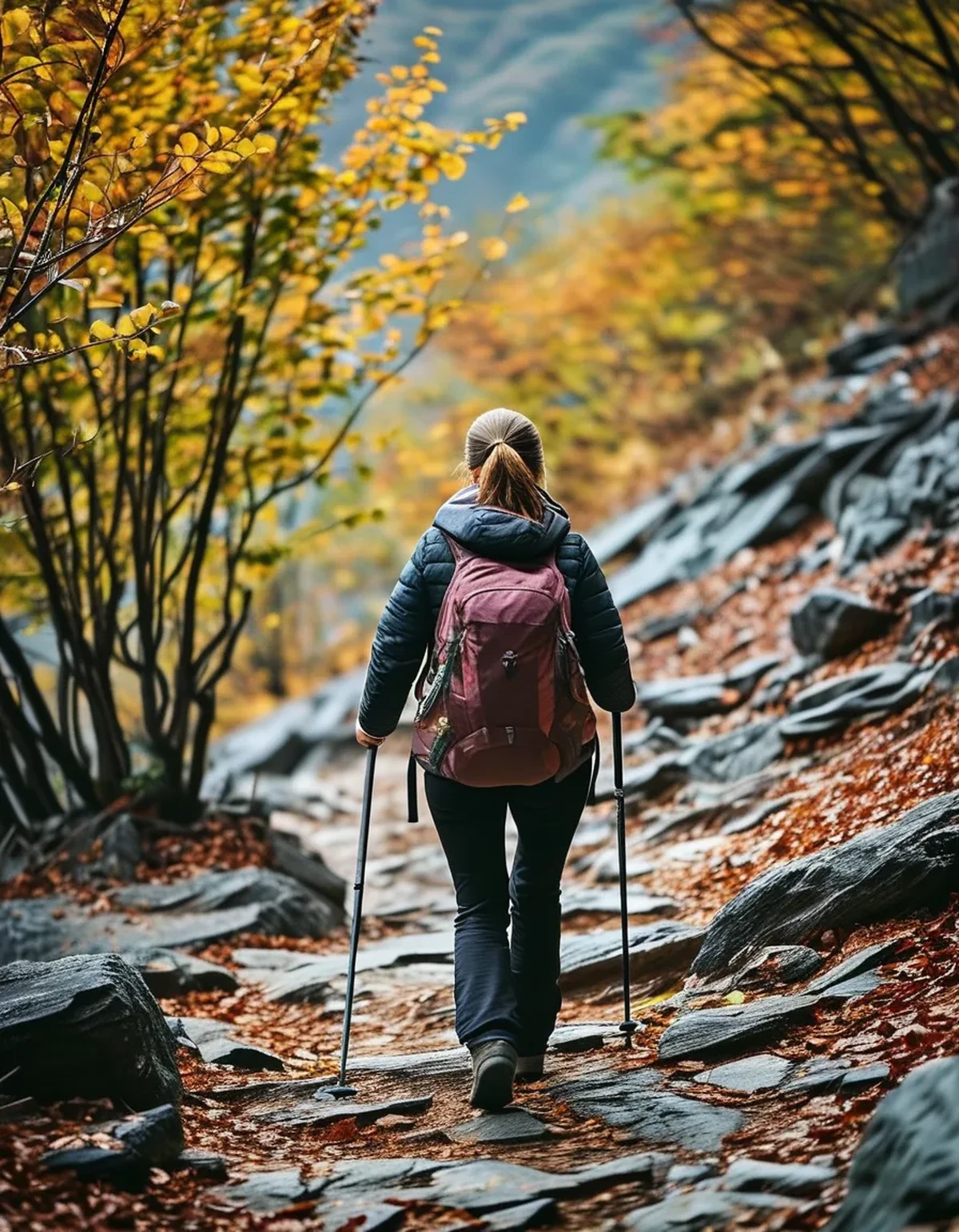
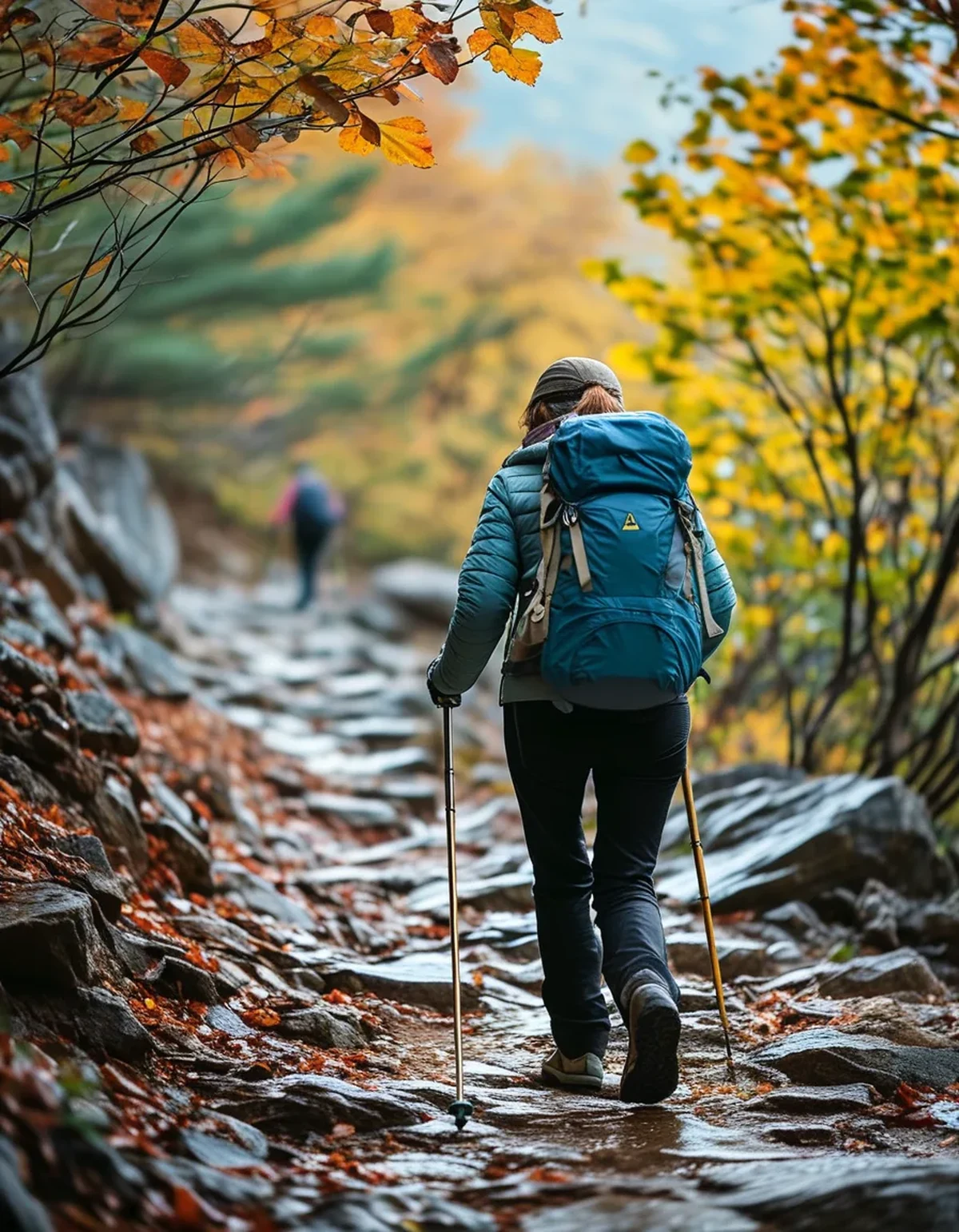
Trekking poles genuinely reduce the load. Estimates vary, but poles used properly on descent can take a meaningful percentage of the force off the legs and transfer it through the arms. They are more valuable going down than going up, which is the reverse of how most people use them.
Boots feel a half size too small on the way down. Feet swell and slide forward. Bruised toenails on descent are nearly always a lacing problem — a heel lock lacing pattern keeps the foot back in the boot and solves most of it.
The soreness is trainable and it adapts fast. A single bout of eccentric loading provides substantial protection against the next one for several weeks — the repeated bout effect. One deliberate downhill session two weeks before a big hike measurably reduces the damage from the main event.
Descending burns fewer calories than you think. Because eccentric work is metabolically cheap, the descent contributes far less to total energy expenditure than its difficulty suggests. Fuel for the climb, not for the whole day evenly.
Knee pain on descent is extremely common and usually mechanical. It responds well to shorter steps, poles, stronger quadriceps, and reduced pack weight. Persistent or sharp knee pain is worth having assessed, but the generic ache is usually a load management issue.
How do you actually train and manage it?
Train the descent specifically, and manage it on the day.
Train eccentrics before the hike. Slow, controlled step-downs from a box — three to four seconds on the lowering phase, three sets of 8 to 10 per leg, twice a week. This is the single most effective preparation and takes ten minutes.
Do one downhill-specific session. Walk down a hill or a long staircase repeatedly, two weeks before a big hike. Expect soreness. That soreness is the protective adaptation being purchased.
On the day: shorten your stride. Small quick steps, landing softly with a slightly bent knee. Never lock the knee on landing — a straight leg transfers force directly to the joint.
Use poles, set slightly longer than for ascent. Plant them ahead of you and let the arms absorb part of each step. This is the largest immediate reduction in leg load available.
Traverse rather than descend straight down on steep sections where the trail allows. Zigzagging reduces the drop per step at the cost of distance, and it is a trade worth making on the steepest ground.
Budget time and energy honestly. A common planning error is allocating a third of the day to the descent because it covers the same distance faster. Plan for the descent to take roughly as long as the climb when the terrain is technical, and stop for a real break at the summit rather than pushing straight through.
This is general information, not medical advice. Persistent joint pain during or after hiking is worth having assessed by a professional.
FAQ: Descent Questions, Answered
How long does the soreness last?
Typically peaking at 24 to 72 hours and resolving within five days. Gentle movement — walking, easy cycling — helps more than complete rest, though it feels counterintuitive.
Do knee braces help?
For some people with specific conditions, meaningfully. For general descent ache, stronger quadriceps and better technique outperform bracing. A brace treats the symptom of a load the muscle could not manage.
Is it better to descend fast to get it over with?
No. Faster descent means higher impact force per step and worse control as fatigue accumulates. Slower with shorter steps produces less damage in total, even though it takes longer.
This is general information, not medical advice.
TL;DR:
- Descending is eccentric loading, which causes far more muscle damage than climbing at a fraction of the energy cost.
- It feels easy because breathing eases and muscle damage produces no immediate signal.
- Shorten your stride, keep a soft knee, and use poles — poles help more going down than up.
- Train slow step-downs twice a week, and do one deliberate downhill session two weeks before a big hike.
On your next hike, plan the descent as a separate event with its own time and energy budget. That single planning change removes most of the Tuesday soreness.
Keep Reading
This article is for general informational and styling purposes only. Fit, sizing, and product availability may vary.