Why the Same Trail Takes 40 Minutes Longer in Autumn
Quick Answer: Autumn trails take longer because wet leaves and mud reduce footing and force shorter, more careful steps; layering stops eat into moving time; and the light fades faster and earlier than the forecast suggests. Plan for 20-30% more time than your summer pace on the same route and set a turnaround by the clock, not by distance.
You have done this loop a dozen times at around three hours. In October it took closer to four, and you finished the last stretch by headlamp.
Nothing went wrong. Autumn genuinely changes the arithmetic of a familiar trail, in several ways at once, and almost none of them show up in a forecast.
Here is what changes and how to plan for it properly.

Why does footing slow you down so much?
Because your pace on a trail is set by how confidently you can place your feet, and autumn removes that confidence.
Wet leaves are genuinely slippery and they hide the trail surface. A leaf layer conceals roots, rocks, holes, and mud. Every step becomes a small assessment rather than an automatic placement, and that assessment costs time on every stride.
Mud is worse on the descent. Descending is where footing matters most and where slips are most consequential. Careful descending is much slower than careful climbing, and this catches people out because the descent is usually where they expect to make up time.
Your stride shortens automatically. On uncertain ground, people naturally take shorter steps and keep their weight more centered. That is exactly the right instinct and it costs perhaps 15-20% of your pace without you noticing.
Practical responses:
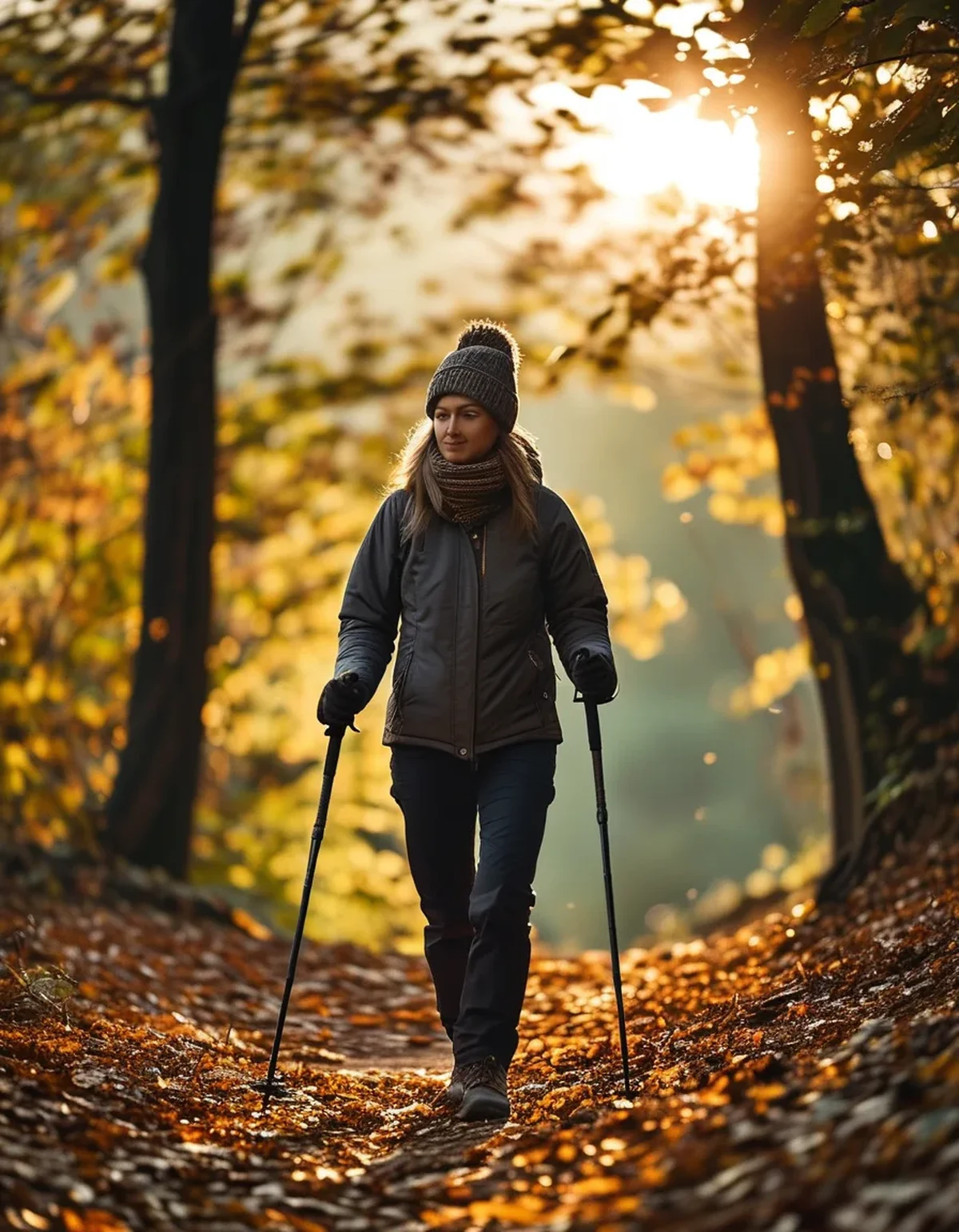
- Use trekking poles. In autumn conditions they are transformative rather than optional — two extra contact points on ground you cannot fully read.
- Check your tread. Worn boots on wet leaves are the season’s most common cause of falls.
- Accept the slower descent. Trying to hold summer descent speeds on wet leaves is how ankles get turned.
Where does the rest of the time actually go?
Three places, and layering is the biggest.
Layer management is a real time cost. In summer you dress once. In autumn you stop to remove a layer at the first climb, put it back on at the exposed ridge, take it off again on the next climb. Five stops of four minutes each is twenty minutes, and nobody counts them.
The fix is a layering system designed for movement: a wind layer that comes off in one motion, a vest instead of a jacket, pit zips instead of full removal. Layers you can adjust while walking cost nothing.
Photography. Genuinely a factor in autumn, and worth planning for rather than pretending you will not stop. Foliage, low light, and better views through bare branches all invite it. Just budget it.
Snack and water stops take longer. In the cold you are less inclined to eat, so it takes a deliberate stop rather than eating on the move. Keep food somewhere reachable and eat while walking where the terrain allows.
Navigation slows down. Fallen leaves obscure trail tread, and trails that are obvious in July can be genuinely hard to follow in November. Junctions require more attention, and occasionally a backtrack.
How do you plan for the light?
This is the part that turns a long day into a headlamp finish, and it is entirely predictable.
You lose daylight fast in autumn — a few minutes a day, which compounds to hours across the season. A start time that worked in September finishes in the dark in late October.
Under tree cover, usable light ends well before official sunset. In a wooded valley or on an east-facing slope, it can be functionally dark 30 to 45 minutes before the sun officially sets. Plan to the light you will actually have, not to the sunset time.
The planning method that works:
- Work backwards from sunset minus one hour. That is your target finish. Subtract your realistic autumn duration to get your start time.
- Add 20-30% to your summer time for the same route as the baseline estimate.
- Set a hard turnaround time, not a turnaround point. If you have not reached the summit by the time you set, turn around. This one rule prevents most autumn epics.
- Carry a headlamp regardless. Every hike, even a short one. With spare batteries, since cold reduces battery capacity noticeably.
- Know the bail-out options on your route before you start.
5 Mistakes That Turn an Autumn Hike Into an Epic
1. Using your summer time estimate. The single most common error. The trail did not get longer; it got slower. Plan for 20-30% more.
2. Starting late because the morning was cold. Waiting for it to warm up costs you the light at the other end. Start on time in layers and take them off as you warm.
3. Assuming the trail is dry because the sky is. Autumn trails hold water for days after rain, and shaded sections stay muddy long after open ones dry. Recent weather matters more than today’s forecast.
4. Bringing summer water and food quantities. You drink less by instinct in the cold and still need it, and cold weather raises your energy demand. Carry a hot drink in a flask — it does more for morale on a cold summit than anything else you can put in a pack.
5. Not carrying a warm layer for stops. You are warm while moving and you cool very fast when you stop. A packable insulated layer that lives in your pack unused all day is exactly the right thing to be carrying.
What should you change about your kit?
Autumn kit differs from summer kit in specific, worthwhile ways.
Boots with genuine tread, and check the wear. Traction is your primary safety feature this season.
Trekking poles, even if you do not usually use them. Two extra points of contact on leaf-covered ground is the highest-value change available.
Gaiters if there is mud. They keep debris out of your boots and your lower legs dry, and they weigh very little.
A packable insulated layer that stays in the pack for stops and emergencies.
A waterproof shell, not just a water-resistant one. Autumn rain is colder and more persistent, and being wet at 45°F is a genuine problem rather than a discomfort.
Headlamp plus spare batteries, every hike.
A hot drink in a flask. Not essential and it changes the whole day on a cold summit.
Dry clothes waiting in the car. Changing out of damp layers immediately at the trailhead is where you actually avoid getting chilled — most people get cold after the hike, not during it.
FAQ: Autumn Hiking Questions, Answered
How much extra time should I really allow?
Twenty to thirty percent over your summer time on the same route is a reliable starting point for typical wet-leaf and mud conditions. Add more if the route has significant descent, if it has rained in the past few days, or if you are hiking somewhere unfamiliar where navigation will be slower.
Are trekking poles worth it if I have never used them?
In autumn specifically, yes — this is the season where they matter most. They reduce load on the knees during descent by a meaningful margin and give you two extra contact points on ground you cannot fully read. Set them slightly longer for descending and shorter for climbing, and give yourself one hike to get used to them.
What if I do end up finishing in the dark?
Slow down substantially, put the headlamp on before you need it rather than after, and stay together if you are in a group. Navigation is much harder in the dark, so check your position more often than feels necessary. If you are unsure of the route and have shelter and layers, waiting for light is sometimes the better decision — but this is exactly the situation that turnaround times exist to prevent.
TL;DR:
- Wet leaves and mud shorten your stride and slow descents; expect 20-30% more time than your summer pace.
- Layer stops, photo stops, and slower navigation account for most of the rest.
- Usable light under tree cover ends 30-45 minutes before official sunset — plan backwards from sunset minus an hour.
- Set a hard turnaround time, not a turnaround point, and carry a headlamp on every hike.
- Poles, tread, a packable insulated layer, and a real waterproof are the kit changes that matter.
Autumn is the best hiking of the year — better light, cooler climbing, quieter trails. It just runs on a different clock than the trail you remember from July.
Keep Reading
This article is for general informational and styling purposes only. Fit, sizing, and product availability may vary.