The Thigh Chafe Playbook for Long Trail Days
Quick Answer: Chafe needs three ingredients — repeated friction, moisture, and salt — and a long August hike supplies all three in abundance: thousands of steps, humidity that keeps sweat from evaporating, and drying sweat that leaves abrasive salt crystals on softened skin. The playbook has three layers: fabric coverage between the thighs before the first step (snug smooth knit, flat seams), lubricant applied generously and reapplied every couple of hours, and immediate response at the first hot-spot sting — because chafe caught at the tingle stage costs two minutes, and chafe ignored for a mile costs the week.
Every size of hiker chafes — thru-hikers treat anti-chafe as standard kit, not a confession. The only mistake is packing hope instead of a plan.

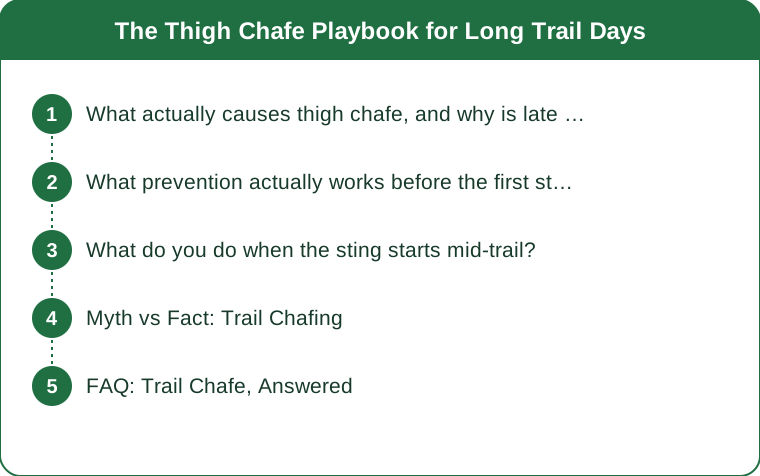
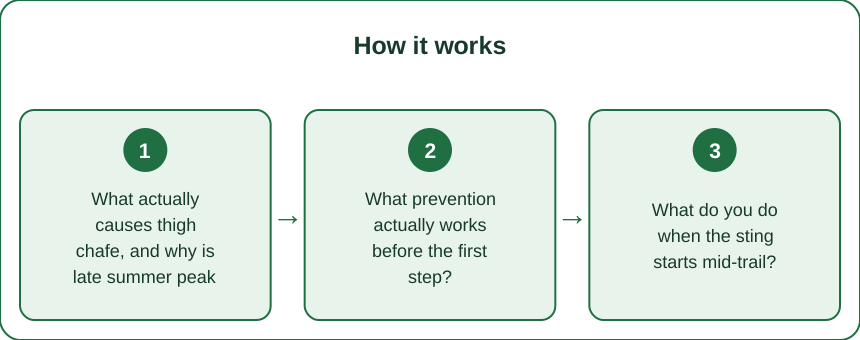
What actually causes thigh chafe, and why is late summer peak season?
Three ingredients, each multiplied by August.
Friction is the engine. Inner thighs pass each other with every stride — a modest day-hike is 15,000-plus strides, and each pass rubs skin against skin or fabric against skin. No single pass does anything; the accumulation is everything, which is why chafe is a mileage injury that shows up mid-hike rather than at the trailhead.
Moisture is the multiplier. Wet skin is dramatically weaker than dry skin — sweat-soaked skin softens and abrades far faster, the same maceration mechanism behind wet-shoe blisters. Late summer humidity means sweat stops evaporating efficiently, so the skin stays saturated for hours. The identical hike in dry October air produces a fraction of the damage.
Salt is the sandpaper. As sweat cycles between wet and half-dry, it leaves microscopic salt crystals on skin and fabric — fine grit worked into every subsequent pass. This is why the second half of a hot hike escalates so fast: the abrasive load has been building since mile one.
Terrain stacks the deck further: descents widen and vary your stride, water crossings and creek splashes re-wet everything, and a pack changes your gait subtly by mile five. August hands you the full recipe — which is exactly why the prevention has to be layered rather than hopeful.
What prevention actually works before the first step?
Three layers, applied in order of reliability.
Layer one: fabric between the thighs — the single highest-value decision. Skin that never touches skin cannot chafe on it. Snug coverage to mid-thigh — fitted bike-short styles, or full high-waisted leggings — converts skin-on-skin friction into fabric-on-fabric glide. The spec matters: smooth buttery-soft knit (rough textures are sandpaper at mile eight), flat or bonded seams positioned away from the contact zone, and genuinely snug fit — loose fabric rides up, bunches, and creates its own friction edges, which is why baggy shorts are the worst chafe garment on the trail. Under skirts and loose shorts, a fitted short layer underneath delivers the same protection. And never cotton against the contact zone: it soaks, stays wet, and stiffens as salt dries into it.
Layer two: lubricant, applied like you mean it. Anti-chafe balms and sticks lower friction dramatically while adding light water resistance. Apply generously at the trailhead to the full contact zone — wider than you think, since sweat spreads the zone as miles add up. The universally skipped step: reapplication. No balm survives four sweaty hours; every two to three hours, or immediately after water crossings, is the working interval. The stick lives in the hip-belt pocket, not the car.
Layer three: moisture management. Wicking underwear and layers, a brimmed hat that keeps sweat from running south, and on multi-day trips a quick fresh-water rinse of the contact zone at lunch — rinsing off the salt grit resets the sandpaper problem in ninety seconds.
Do all three on any hike past two hours in August heat. The layers back each other up precisely where each one fails.

What do you do when the sting starts mid-trail?
Respond at the tingle, not the burn — the entire outcome is decided in that window.
Stop within minutes of the first hot spot. The progression from warm awareness to raw skin runs fast under continued friction, and it does not reverse while you keep walking. Two minutes now saves the day; a stoic mile costs the week. Find shade, drop the pack.
Dry, then re-lubricate. Pat the area dry — bandana, spare sock, anything — because balm over wet salty skin seals the problem in. If water is available, rinse the salt first, dry, then apply a thick, generous layer well past the edges of the hot spot.
Change the fabric equation on the spot. Roll or pull the legging hem to move a seam off the contact line, swap into the spare shorts if carried, or improvise a barrier — a folded buff makes a serviceable emergency liner. On descents, shorten your stride slightly; the wide downhill gait is the highest-friction stride of the day.
If skin is already raw: a strip of kinesiology tape or a large hydrocolloid blister patch over the area, edges rounded, functions as second skin and can rescue the remaining miles. This is the argument for the tiny chafe kit — stick, tape, two patches — that weighs less than a granola bar.
At the trailhead: rinse gently with plain water (the shower will announce every spot regardless), pat dry, and apply a plain moisturizer or a zinc-based barrier cream. Skip exfoliation and fragranced products for a few days. Skin that is broken, weeping, spreading in redness, or not clearly improving within two or three days has crossed from chafe into a wound that deserves proper care — and unusually painful or infected-looking skin belongs with a clinician.
Myth vs Fact: Trail Chafing
Myth: Chafing only happens to bigger bodies. Fact: Marathoners of every build tape their thighs and marathon photos prove it — chafe follows friction plus moisture plus miles, full stop. Body shape changes where it happens more than whether. The prevention playbook is identical at every size, and so is the relief of finally running it.
Myth: Your skin toughens up if you push through. Fact: Repeatedly damaged skin does not become trail-hardened; it becomes damaged more easily, and healing skin is more vulnerable on the next hike. Calluses are a foot phenomenon — inner-thigh skin never develops them.
Myth: Powder is the best prevention. Fact: Powder works only while dry — an hour into a humid hike it is paste, and paste is grit. Powders suit low-sweat contexts; sustained trail miles want a balm or fabric barrier that functions wet.
Myth: Looser clothes mean less rubbing. Fact: Loose fabric moves against skin with every stride and its edges saw at the contact zone — the baggy-shorts hike is a classic chafe origin story. Snug and smooth beats loose and breezy in the friction zone.
Myth: New activewear is trail-ready out of the package. Fact: Sizing quirks, seam placement, and ride-up behavior only reveal themselves with miles — and fabric softener residue from washing can blunt wicking. Break new gear in on a short walk, wash activewear without softener, and save the long day for proven kit.
FAQ: Trail Chafe, Answered
What should I look for in an anti-chafe product?
A stick or balm that stays slick under sweat — the established sport formulas are built exactly for this. Plain petroleum jelly works and costs little, though it wears off faster and stains fabric. Whatever you choose, the reapplication habit matters more than the brand.
Leggings or shorts when it is genuinely hot?
Either works if the contact zone is covered: lightweight high-waisted leggings in a thin wicking knit run cooler than people expect and add sun protection; fitted bike-short layers under anything looser give coverage plus airflow. The losing option is bare thighs plus hope.
Does chafing mean my leggings are the wrong size?
Sometimes — hems that ride up and expose the contact zone mid-stride are a fit signal, as are seams that sit exactly where your thighs pass. Right size, smooth knit, flat seams, and the garment disappears from the equation, which is the goal.
How do I stop my leggings from causing chafe at the waistband too?
Same recipe, different address: a waistband that is too loose slides and rubs under a pack’s hip belt, and salt collects along the elastic. Snug high-rise fit that the hip belt can sit over cleanly, balm along the band on big days, and rinse the band area at breaks on multi-days.
TL;DR:
- Chafe = friction x moisture x salt, and August maximizes all three — it is a mileage injury that escalates from mile one’s invisible buildup.
- Prevention layers: snug smooth fabric across the contact zone, generous balm reapplied every two to three hours, and moisture-and-salt management.
- Respond at the first tingle: dry, rinse salt if possible, re-lubricate wide, adjust fabric, tape if raw — two minutes early beats a ruined week.
- Every body size runs this playbook; the only real mistake is having no plan at all.
Build the pocket kit tonight — balm stick, four inches of tape, two hydrocolloid patches — and it lives in the pack from now on. The hike where you never think about your thighs once is the whole point.
See It in Motion
Seen here: High Waist 8” Yoga Shorts — shop similar styles on bubblelime.com
Keep Reading
This article is for general informational and styling purposes only. Fit, sizing, and product availability may vary.