How to Actually Decode Trail Difficulty Ratings Before You Commit to a Hike
Quick Answer: Trail difficulty labels (easy/moderate/hard) are inconsistently applied across parks and apps — elevation gain per mile, total distance, and surface type tell you far more reliably what a hike will actually feel like than the label alone, so check those three numbers specifically before trusting a difficulty rating.
A “moderate” trail in one park system can be considerably harder than a “hard” trail in another — the label alone isn’t a reliable planning tool on its own.

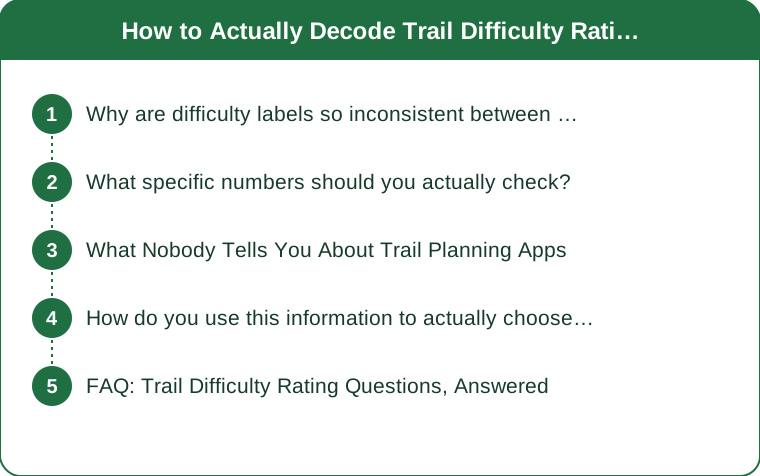
Why are difficulty labels so inconsistent between sources?
There’s no universal standard for what makes a trail “easy,” “moderate,” or “hard” — individual park systems, apps, and trail guides each apply their own internal scale, often calibrated to their typical visitor base rather than any fixed metric. A park with mostly flat trails may label a modest hill “hard” relative to its other offerings, while a mountainous park might call the same hill “easy” by comparison.
This is exactly why cross-checking the underlying numbers, not just the label, gives a much more reliable picture before committing.
What specific numbers should you actually check?
Elevation gain per mile is the single most useful number for predicting actual physical difficulty — a rule of thumb some hikers use is that 200+ feet of gain per mile starts to feel meaningfully more strenuous, and 500+ feet per mile is genuinely demanding regardless of total distance. Total distance matters obviously, but less than most people assume relative to elevation gain — a flat 8-mile trail is often easier than a hilly 4-mile one.
Surface type (paved, packed dirt, loose rock, roots) changes footing difficulty and pace independent of both distance and elevation — a rocky, technical trail can take twice as long per mile as a smooth packed-dirt trail of the same length and elevation profile.

What Nobody Tells You About Trail Planning Apps
Crowd-sourced difficulty ratings on hiking apps reflect the average opinion of that app’s typical user base, which skews toward more experienced, frequent hikers on some platforms — meaning a rating that feels accurate to a seasoned hiker community might understate difficulty for someone newer to hiking or working with different physical considerations.
Reading a handful of recent written reviews (not just the star rating) often surfaces much more specific, useful detail — mentions of steep sections, exposed sun, or technical footing that a single difficulty number can’t capture.
How do you use this information to actually choose a hike?
Before committing, check the elevation gain per mile figure specifically (most trail apps list this even when the difficulty label seems vague), cross-reference a couple of recent reviews for surface and pacing notes, and factor in real-world conditions like expected weather and available shade, which affect actual difficulty as much as the trail’s fixed stats.
Starting with a trail whose numbers land comfortably within a range you’ve already handled successfully, then gradually increasing elevation gain or distance on future hikes, builds a much more reliable personal calibration than trusting difficulty labels alone.
FAQ: Trail Difficulty Rating Questions, Answered
Is there any standardized trail difficulty system at all?
Some regions and specific trail systems use more standardized scales (like the Yosemite Decimal System for climbing-adjacent terrain), but most everyday hiking trail labels remain locally and inconsistently applied.
How much does elevation gain per mile actually change perceived difficulty?
Significantly — many experienced hikers report that elevation gain affects perceived effort more than total mileage, which is why two trails of the same length can feel completely different.
Should beginners avoid trails rated “moderate” or higher entirely?
Not necessarily — checking the specific elevation and surface numbers behind a “moderate” rating often reveals it’s manageable; the label alone shouldn’t be the sole deciding factor either way.
TL;DR:
- Difficulty labels aren’t standardized — the same word means different things across parks and apps
- Elevation gain per mile predicts actual difficulty more reliably than distance or the label alone
- Surface type changes pace and effort independent of both distance and elevation
- Check recent written reviews, not just the star rating, for specific trail conditions
Keep Reading
This article is for general informational and styling purposes only. Fit, sizing, and product availability may vary.